検索キーワード「esperanto」に一致する投稿を関連性の高い順に表示しています。 日付順 すべての投稿を表示

2012年12月15日土曜日

Esperanto 125周年の あれこれ


Esperanto Turns 125!

MONTREAL, QUEBEC--(Marketwire - Dec. 11, 2012) - This December 15th Esperanto speakers around the world will celebrate the 125thanniversary of the creation of Esperanto. Over the course of time, a worldwide Esperanto speaking community has developed, complete with its own transnational culture.
Since the birth of this egalitarian language, thousands of Quebecers and millions of people from more than 120 countries have learned Esperanto. There are even families who use Esperanto as their home language on a daily basis and whose children grow up speaking the language.
Esperanto is officially taught in 150 universities and other institutions of higher learning and in 600 primary and secondary schools in 28 countries.
Esperanto has a rich body of literature consisting of more than 50,000 titles, with new publications released every week throughout the world.
The UN maintains consultative relations with the World Esperanto Association (UEA), and UNESCO encourages its member states to teach the language.
Lastly, the internet has given a new impetus to the spread and usage of Esperanto. Google offers its interface in Esperanto, as do Facebook and Vikipedio, the Esperanto version of Wikipedia, which, with over 170,000 articles, ranks as 28th most used language in Wikipedia.
On December 15th Quebec Esperantists will celebrate the 30th anniversary of the Quebec Esperanto Society, the 50th anniversary of the Montreal Esperanto Club, and the 125th anniversary of Esperanto.
P.S. Even Canada Post's Santa Claus answers children's letters in Esperanto!

Celebración del "día del esperanto" en varias ciudades

El próximo día 15 de diciembre (つまり今日 hoy)  se celebra en todo el mundo el Día Internacional del Esperanto. Este año la celebración es especial, ya que coincide con el 125 aniversario del nacimiento de este idioma universal, que se ha conmemorado este año.


La mayoría de clubes y asociaciones que promueven esta lengua han organizado actividades festivas o conmemorativas. En unos casos se trata sobre todo de disfrutar de las posibilidades comunicativas y culturales del esperanto. En otros se aprovechará la ocasión para informar al público general sobre el estado actual y perspectivas de este medio de comunicación tan desconocido.
El día 15 tendrá lugar en Madrid un conjunto de conferencias y presentaciones con el título global “El valor del esperanto como fenómeno intercultural”. Se celebrará durante todo el día en el Centro Cultural Galileo, en la calle Galileo, 39, de Madrid, y será abierta al público, quien puede asistir libremente a las actividades que sean de su interés. Por la mañana las conferencias se desarrollarán en español y abarcarán diversos temas relacionados con el idioma esperanto y su estado actual. Por la tarde habrá charlas en esperanto, pero también un recital bilingüe de poemas y la proyección de una película sobre el esperanto, en inglés, con subtítulos en castellano. Puede accederse a mayor información en http://bit.ly/konferenco
Los días 15 y 16 se celebrará en Granada el 17º Congreso Andaluz de Esperanto, que reunirá a esperantistas de esa región, y visitantes de otros lugares de España y de fuera de nuestras fronteras. El programa y características pueden verse en http://www.esperantoandalucia.com/#
Distintos encuentros y charlas tendrán lugar en otras ciudades, como Zaragoza (donde a comienzos de mayo tendrá lugar el próximo Congreso Español de Esperanto), Valencia, Barcelona, Bilbao, Santander y otras.
Si desean información más concreta, o si desean conocer más sobre el esperanto, pueden visitar la página web de la Federación Española de Esperanto, http://esperanto.es o si desean ponerse en contacto con la Federación Española de Esperanto para saber más sobre el idioma o para conocer a algunos de sus hablantes, pueden hacerlo en la dirección info@esperanto.es.

Esperanto came into existence about 125 years ago - nowadays, it has speakers around the globe. Although political forces limited its spread in the last century, it's now becoming increasingly popular.
It's not known exactly how many people speak Esperanto - estimates range from half a million to 2 million people worldwide, most of whom live in Europe. In Germany, about 100,000 people know the "planned language."
Ludwig Lazarus Zamenhof, a doctor and philologist from Bialystok, Poland, created the language at the end of the 19th century, while the first Esperanto book was published in 1887. Zamenhof, who lived in the region when it was still a part of Russia, wanted to create a medium for understanding that would bring people from different nations and cultures together, and in the process promote world peace.
Political barriers
The fact that the language has only a few hundred thousand speakers after 125 years is due primarily to political barriers, explained historian Ulrich Lins, who was deputy director of the Universal Esperanto Association for some years.
Ludwig Lazarus Zamenhof, inventor of Esperanto. 15.12.1859 - Warschau 14.4. 1917. Zamenhof invented Esperanto to help bridge cultural barriers during the nationalist era he lived in
"Especially in Nazi Germany and in the Soviet Union, the language was considered dangerous, a means of subverting national interests," Lins told DW. Esperanto was believed to facilitate the international exchange of information - a crime in those countries at the time. As a consequence, Esperanto speakers were persecuted, Lins said.
Although Esperanto enthusiasts had numerous motivations, they were often especially free-spirited people, cosmopolitans opposed to the excesses of nationalism. "Esperanto was for those who wanted to practice grassroots internationalism," Lins said.
This often placed them near communists and socialists on the political spectrum. And that Zamenhof was Jewish colored its followers even more, in the context of the times.
"After World War II, English became so dominant that Esperanto didn't stand much of a chance," Lins explained.
But in recent years, Esperanto appears to be on the up again. The Internet has made it possible, now more than ever, to communicate across national boundaries. Esperanto could become a medium for overcoming linguistic hurdles in modern times.
International travel made easier
Roland Schnell knows from personal experience that Esperanto can make international travel easier. Schnell is a spokesperson for an Esperanto association in the Berlin area with about 100 members. He says that there are around 1,000 people who can speak the language in the region.
"Couchsurfing has been around in Esperanto since 1974," Schnell told DW. "And the language is used a lot." By couchsurfing, Schnell is referring to an international network of hosts offering free lodging to others. There is often more than just room and board involved, for example, showing guests around the area.
Schnell couldn't speak French, but he told DW that he quickly made contacts in France using Esperanto. Today, he can also understand French.
Numbers unimportant
Schnell thinks it's not important that Esperanto has fewer speakers than English or French. "The total number doesn't matter. It's about voluntarily offering a means of communication that everyone can use," he added.
Esperanto Cultural and Congress Center in Fulda, Germany 19.09.2005) +++(c) dpa - Bildfunk+++Some hotels are using the word "Esperanto" to profile their international character
Esperanto continues to display its practical use, Schnell emphasized. "Wine, whisky and cigar dealers used advertisements in newspapers," he explained. Although such advertisement is increasingly difficult due to the diminishing significance of such papers in the Internet age, there are other possibilities, he told DW.
Currently, the Berlin Esperanto association is planning to attach placards to bicycles distributed around the city. In Warsaw, a public system for sharing some 1,100 bicycles is called "Veturilo," which means vehicle in Esperanto.
Schnell also said that Esperanto is being employed as an effective marketing method. Some hotels have begun to use the word "Esperanto" in their names in order to emphasize the establishment's international character.
Whether or not these initiatives are behind Esperanto's increasing numbers of speakers isn't clear, Schnell said. But the language is clearly attracting more and more followers.

エスペラント人口はいまだに世界で百万から二百万程度と言われていますが、英語などよりもずっと学びやすく、かなり欧州的ではあるにせよ、理想を追求する精神から生まれた言語ですので、英語病の人を初め もっと世界中の人が真剣に再考してくれたらなあと思います。夢乏しき世界の夢の一つではないでしょうか。


2025年3月23日日曜日

Los ángeles perdidos 山河遥かなり The Search (1948) idiomas - A lo largo de estas carreteras caminan gentes que van a un punto determinado o vagan sin rumbo fijo あてどなく / La guerra 8月のメモワール The War スペイン公開 (1996 昨日) A veces es demasiado ('sometimes' is too much) / 本日の無料闘牛中継 Toros desde Tomelloso (Ciudad Real) Castilla La Mancha Media - Novillada desde Cortegana (Huelva) Canal Sur Televisión / 2014/05/27 Global networking through Esperanto (パキスタン発) 再録 /

☝12m11s (最初) 及び 16m34s 〜 (2つ目、3つ目)


☝スペイン語吹き替え版

Los ángeles perdidos 山河遥かなり The Search

公開 アメリカ合衆国の旗 1948年3月23日
日本の旗 1954年6月4日

Karel, un introvertido niño checo de 9 años, superviviente del campo de concentración de Auschwitz, huye de un campo de refugiados en la Alemania de la postguerra, tratando de buscar a su madre. El chico es encontrado por un soldado americano, Steve que tratará de ayudar Karel a encontrarla. Film en tono semi-documental, rodado entre los escombros de la ciudad de Nuremberg y protagonizado por el entonces desconocido Montgomery Clift en su debut en la pantalla.


148
00:26:05,746 --> 00:26:07,829
A lo largo de estas carreteras
caminan gentes

149
00:26:08,150 --> 00:26:11,050
que van a un punto determinado
o vagan sin rumbo fijo


La guerra 8月のメモワール The War 


公開 アメリカ合衆国の旗 1994年11月4日
日本の旗 1995年10月28日

Fecha de lanzamiento

The War (conocida en español como La guerra o El árbol de los sueños) es una película del año 1994 dirigida por Jon Avnet y protagonizada por Elijah Wood y Kevin Costner. Es un sobrecogedor drama que cuenta la historia de una familia pobre de Misisipi luego de que el personaje de Costner regrese de la Guerra de Vietnam en 1970. 

A comienzos del verano de 1970, un hombre regresa de Vietnam, pero no es capaz de sobreponerse a la guerra ni social ni psíquicamente.


domingo 23 de marzo de 2025 

(17:00 España)  Castilla La Mancha Media Toros desde Tomelloso (Ciudad Real). Toros de Herederos de José Luis Osborne para Molina, Álvaro Alarcón y Víctor Hernández. (Pulse aquí para ver el festejo en directo)

(17:00 España)  Canal Sur Televisión Toros desde Cortegana (Huelva). Circuito de Novilladas de Andalucía. Novillos de Espartaco para El Primi, Cid de María y Carlos Tirado. (Pulse aquí para ver el festejo en directo)


                    スペイン


西語・英語レッスン等の申し込み、その他質問等も全て、右上の連絡フォームよりどうぞ。(スマホの方はウェブバージョンに切り替えると連絡フォームが現われます。)また簡単な(年齢・出身地・海外渡航歴等)自己紹介なども添えてください。


👇2014年5月27日の記事が とても visitas が多いようなので再録しました。

今月(つまり2014年5月)初頭 Pakistan の The Nation 紙に以下のような エスペラントについての英語記事が載っていました。


There had been many attempts to develop a neutral international language like Ido and Interlingua. But none gained as much success as Esperanto. It was designed by Ludwig Lazarus Zamenhof in 1880s with an aim to create an easy-to-learn, politically neutral language that would transcend nationality and promote peace and international understanding between people with different languages. The initial work in this language was done by its creator and many books were translated. The first book of Esperanto grammar was published in Warsaw in 1887. With every passing year the language gained popularity and also international recognition. In 1905 the first World Congress of Esperanto was organized in France. Since then congresses have been held in various countries every year with the exception of years in which there were world wars. In 1921 Esperanto was recommended by the French Academy of Sciences and in 1954 it was recognised by UNESCO.
Esperanto has also been used in a number of films and novels. Typically, this is done either to add the exotic flavour of a foreign language without representing any particular ethnicity. The Charlie Chaplin film The Great Dictator (1940) showed Jewish ghetto shop signs in Esperanto. Two full-length feature films have been produced with dialogue entirely in Esperanto. According to an estimate there are 2 million speakers worldwide, with the majority being in Europe, East Asia, and South America. Lernu.net, the most popular online learning platform of Esperanto, reported 150,000 registered users in 2013, and has between 150,000 and 200,000 monthly visitors. Esperanto has a notable presence in over a hundred countries.
The Esperanto alphabet is based on the Latin script, using a one-sound-one-letter principle. The alphabets include six letters with diacritics: ĉ, ĝ, ĥ, ĵ, ŝ (with circumflex), and ŭ (with breve). The alphabet does not include the letters q, w, x, or y, which are only used when writing unassimilated foreign terms or proper names. There are 23 consonants, 5 vowels, and 2 semivowels that combine with the vowels to form 6 diphthongs.


The 2nd South Asian Seminar was recently held in Lahore in which Esperantists of South Asia participated. There were almost five persons who came from other countries and two were from Korea, two from Nepal and one from Sri Lanka. D-ro SO Gilsu from Korea and Prof. Bharat Kumar Ghimire from Nepal talked to Sunday Plus and told how much popularity the language is getting in the world. It is heartening to know that there are people in Pakistan who can understand and speak this language. Prof Saeed Ahmed is one of those who have good knowledge about Esperanto. He served as a translator when D-ro SO Gilsu was explaining facts in Esperanto. Mr Gilsu is an enthusiast about this language and working laboriously for its promotion. He organised the first Esperanto conference in China in 1995.
There is a foremost question that what the need of promoting this language is when the English had already attained the status of an international language. Prof Saeed who has good command over various languages including English, Urdu, Punjabi and Esperanto, said, “History has witnessed that after every three to four centuries international language changed. And the reason is of political backing. If today English is an international language, tomorrow Chinese can get that status. Earlier French was the international language and before that Greek enjoyed the same status.
“The purpose of developing Esperanto is to promote a common international language, which is neutral and has no political backing. Each country or region should talk in its language but there should be at least one language which doesn’t have any suppression or the hegemony on other nations. People can communicate internationally in that language and Esperanto is the language which has no political force behind it,” Mr Saeed said.
D-ro SO Gilsu added on and said that neutral language should be easy to understand. “English belong to English people and Chinese belong to Chinese people. It is only Esperanto which is creating a global family and doesn’t belong to any specific country or nation.” Mr Gilsu, who is as good in English as in Esperanto, shared one of his experiences to explain how Esperanto is creating a global family. He said that once he visited San Francisco and on the airport no English speaking person welcomed him rather Esperantists received and greeted him.
Explaining that how the communication of Esperanto is spreading in the world, he said that tourism is biggest source. “Through tourism and travelling this language is getting popularity. I have travelled almost 72 countries of the world where I communicated with other people in Esperanto. There are many countries where Esperantists host Esperantists coming from other countries and the guests have not to spend even a single penny from his own pocket during their whole stay. There are almost 2000 cities in the world where such facilities are available,” Mr. Gilsu said. Prof Saeed had also travelled 40 countries where he communicated with other people in Esperanto.
When asked that how a common man can learn this language, Prof Saeed replied that majority of Esperanto speakers learned the language through self-directed study, online tutorials, and correspondence courses taught by volunteers. In recent years, free teaching websites, like lernu! had also become popular.
Mr Gilsu who is also a learned professor of economics briefed that how he had used this language to share his expertise with other nations of the world. “I have studied economic history in detail and knew very well how Korea progressed in Economic and delivered lectures in Cuba, Chekhoslovakia, Poland and China in Esperanto. I use this language to disperse my knowledge in the world. Besides, I have also written four books about Esperanto in Korean language,” he said.
According to him if one learns Esperanto before leaning any European language, it would help him a lot in learning English or any other language. Studies have been conducted in New Zealand, United States, Germany, Italy and Australia and the results had demonstrated that studying Esperanto before another foreign language expedites the acquisition of the other, natural, language. This appears to be because learning subsequent foreign languages is easier than learning one's first foreign language, whereas the use of a grammatically simple and culturally flexible auxiliary language like Esperanto lessens the first-language learning hurdle. Esperanto connects people with the whole world and from the very young age a child’s brain become universal. He said that his children learned Esperanto as a second language similarly as in Pakistan everyone learned English. But for them (Koreans) English was a foreign language. “I speak Esperanto with two of my children and resultantly they have learned it. After that they learned English and they felt difficulty in it,” he said. “If any Esperantist from any country visits Seoul, he can stay at my home as a guest. My children communicate with such guests in Esperanto.” He added that he came to Pakistan because of Esperanto. Had this language not existed he might never have visited Pakistan.
Talking about the correspondence and connections between the Esperantists Prof Saeed said decades ago it was difficult but now the development in technology and the Internet had solved the communication problems. “The use of this language is growing rapidly. There are several hundred discussion groups on the Internet. Besides, Esperanto is widely used in the ICQ, MSN, and Skype instant messaging programmes. Computer programmes, for example spelling and grammar checkers and keyboard settings have been created in Esperanto. Programmes such as Open Office, Firefox and many other are available in Esperanto. Similarly popular websites such as Google, Wikipedia and Facebook have Esperanto versions,” he maintained.
Every language flourishes because of its literature. Esperanto is a language which doesn’t belong to any specific country or nation. So the next question which comes into the mind is about the literature available in Esperanto and how it will flourish more. Prof. Saeed replied that there were a lot of books translated in Esperanto. “The first book was translated in Esperanto in 1887. The Holy books like the Bible and the Holy Quran have also been translated. There is also a very good book about the Holy Prophet (PBUH). There are books about Confucianism. But now the original literature is also coming,” he said.
There are many universities which have included Esperanto in courses on linguistics, while a few offer it as a separate subject. The University of Poznan in Poland offers a degree programme in inter-linguistics.
The PEN International has recognised Esperanto’s flourishing literary tradition. The Esperanto Literature Academy, founded in 2008, promotes writing in Esperanto. Writers in Esperanto include the novelists Trevor Steele (Australia), István Nemere (Hungary), Spomenka Štimec (Croatia), and Manuel de Seabra (Catalonia); poets Mauro Nervi (Italy), Mao Zifu (China), Mikhail Gishpling (Israel), and Abel Montagut (Catalonia); and the essayists and translators Probal Dasgupta (India) and Humphrey Tonkin (United States). The Esperanto poets William Auld, Marjorie Boulton, and Baldur Ragnarsson, have been proposed for the Nobel Prize in Literature.
Similarly most recent translations into Esperanto include Shakespeare’s The Winter Tale, Manzoni’s The Betrothed, The Lord of the Rings by J.R.R. Tolkien, One Hundred Years of Solitude by Gabriel García Márquez, Maitreyi by Eliade, The Fateful Adventures of the Good Solider Ŝvejk by Hašek, the Chinese classic Pilgrim to the West by Wu Cheng’en and the Vietnamese epic poem The Tale of Kieu by Nguyen Du. Besides, there are over 100 magazines and journals which are being published regularly in Esperanto, including the monthly news magazine Monato, the youth magazine Kontakto, and UEA’s Esperanto magazine.
There are also regular publications about medicine, science, and religion, as well as educational publications, literary reviews, and publications on special-interest topics.
Prof. Bharat Kumar Ghimire from Nepal revealed some details about Esperanto in Nepal. He said, “The number of Esperantists in Nepal is increasing rapidly. There are almost 200 people who can understand Esperanto and almost 50 who can speak it fluently. But Nepal Esperanto Association is working hard to increase this number.”
Answering the question that who funds for the development of this language, Prof. Bharat said that people contributed to run that organization. “There are very strong movements in Japan and China. More and more students are coming and learning this language. There are institutions which teach the language free of cost. There is also a Beijing Radio Station which telecast programme about this language,” he said.
According to Prof. Saeed there are lot of people in Pakistan who are affiliated to this language but those who can speak it fluently could be counted on figure tips.
Developing Esperanto as a common language will help the people to communicate in a single language. It will not only remove the language barrier among different nations but also end the language hegemony of one nation over the other. People will feel more equal from linguistic standpoint while communicating in Esperanto.

英語よりはずっと益しだと思うのですが、この英語帝国主義時代にはどう戦い抜くべきでしょうか。日本も以前はもっと盛んだったのですが。希望を持ち続けましょう。Esperanto です。

後2週間余り、来月12日はエスペラントの日であります。


赤ん坊だって エスペラントを話します Bebé habla esperanto


にほんブログ村 海外生活ブログへ
にほんブログ村

2014年7月26日土曜日

ブエノスアイレスでエスペラント国際大会 EL ESPERANTO CELEBRA SUS 127 AÑOS CON UN CONGRESO INTERNACIONAL EN BUENOS AIRES (Xornal Galicia 紙より)


La Federación Española de Esperanto, junto con el resto de la comunidad esperantista mundial, celebra este 26 de julio el aniversario de la publicación del libro en el que por primera vez se proponía una nueva lengua, que pretendía romper las barreras de comunicación entre los pueblos, y que pronto sería conocida como esperanto.


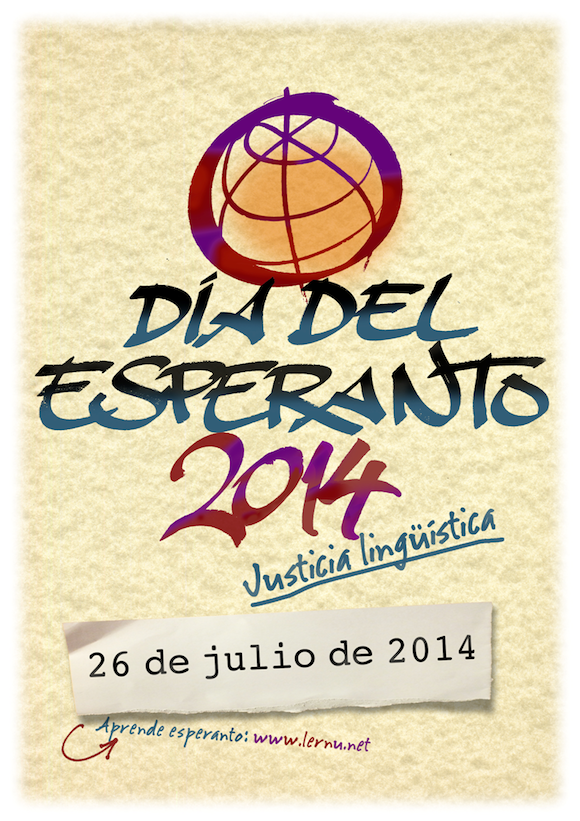
Este año la celebración se conmemora bajo el lema "Justicia lingüística", y coincide con el comienzo del 99 Congreso Internacional de Esperanto, que por primera vez se desarrollará en la capital argentina, Buenos Aires.
Ese día, el 26 de julio de 1887, la censura imperial rusa daba su permiso para que un joven doctor de Varsovia publicase su propuesta de un idioma que sirviera para unir a todas las personas por encima de barreras étnicas o estatales. A ese primer libro le seguirían pronto muchos otros, difundidos por una comunidad de seguidores y hablantes que hoy, más de un siglo y cuarto después, continúa expresándose en una lengua que es de todos, y con la que nadie se siente extranjero.
Ese concepto de igualdad entre los hablantes de la lengua es fundamental en el planteamiento del idioma esperanto. Por esta razón, el cartel diseñado este año por la Asociación Internacional de Esperanto, y que puede verse en estos enlaces en todas las lenguas oficiales españolas, hace hincapié en este concepto de justicia lingüística para todos.
Este año se conmemora además el 60 aniversario de la resolución por la que la UNESCO reconocía los valores culturales del esperanto. La efeméride tiene un significado especial para los países de Iberoamérica, donde este año se han organizado las conmemoraciones más significativas del movimiento esperantista organizado. La capital de Uruguay, Montevideo, la ciudad donde se aprobó la resolución de la UNESCO, ha sido elegida por la Liga Internacional de Profesores de Esperanto para llevar a cabo su conferencia anual. Y el mismo día 26 comienza en Buenos Aires el 99 Congreso Internacional de Esperanto, el encuentro más representativo en este idioma, que se celebra cada año desde 1905. Una cincuentena de españoles participan en este encuentro en representación de las organizaciones esperantistas de nuestro país.
Si desean conocer más sobre el esperanto, sobre su estado actual y sobre sus hablantes, pueden visitar la página web http://www.esperanto.es, escribir al correo prensa@esperanto.es o llamar al teléfono 638547104.
Federación Española de Esperanto· Rodríguez San Pedro 13-3-7, 28015 Madrid ·
Tel. 914468079. Móvil 638547104 · http://www.esperanto.es · prensa@esperanto.es ·
http://www.facebook.com/esperanto.es · https://twitter.com/esperantoes · http://www.youtube.com/esesperanto
ESPERANTO – Una lengua de todos para entenderse – ESPERANTO – Una lengua en defensa de todos los idiomas – ESPERANTO


Esperanto 125周年の あれこれ


赤ん坊だって エスペラントを話します Bebé habla esperanto


米国でも エスペラント Esperanto speakers from around the globe come to Raleigh


Esperanto está vivo エスペラントは生きている


Esperanto nació エスペラント誕生 (1887年)


      にほんブログ村 海外生活ブログ スペイン情報へ


2013年7月8日月曜日

米国でも エスペラント Esperanto speakers from around the globe come to Raleigh


To hear Esperanto spoken is to remember a song whose words you can't quite place but the tune you can hum.
Your ear will detect the lilt and sensuality of Spanish and French, the percussiveness of Russian and German. And yet a newcomer can understand little of it. Esperanto sounds familiar and foreign at the same time.
"The challenge is perhaps not the language but the fact that people think we are crazy," laughs José Antonio Vergara, a doctor from Chile. He is teaching an advanced class—a Supera Kurso—during the North American Esperanto Course in Raleigh this week. "They ask, 'Why are you wasting time with this dead language?' They don't know what they're missing. The experience of Esperanto is so deeply human."
More than 50 of Esperanto's most ardent practitioners from at least 15 countries are convening at William Peace University for the annual U.S. Esperanto Congress July 5–8. At least 2 million people worldwide speak Esperanto, although that's an estimate, as its popularity has increased as a result of the Internet.
"It's like asking how many people know shorthand," says Chuck Mays of Raleigh, who co-organized the congress.
The speakers' embrace of Esperanto supersedes a love of language; they also share a common ideal articulated by Ludwik Zamenhof, a Jewish doctor who invented Esperanto in 1887. In a story from Genesis, God created different languages to foil the construction of the Tower of Babel. By creating an international language, Zamenhof set out to achieve the opposite. He envisioned a common language that promoted peace, one that would break down barriers between people and nations.
Yet language is more than vocabulary and grammar. As a transmitter of memory, culture and identity, it can be used to exclude, to dominate and to gauge assimilation. In Quebec, rivalries between French and English as the official language escalated to the Canadian Supreme Court. In the U.S., the English-only movement marginalizes not only Spanish as a language but also Latinos as a people.
"When you speak English, there is someone with the rights to that language," Vergara explains. "Esperanto belongs to everyone. It is more democratic."

On a recent rainy morning, Margo Cohen, a doctor from Washington, D.C., sits in the intermediate Esperanto class, even though she's been studying the language for only four months. Like most Esperantists, she's a polyglot, speaking German, French, Spanish and Hebrew.
Esperanto, however, had a special appeal. "I fell in love with the idea it's an international language that can serve as a second language and can be a passport for the whole world," she says. "It's a fun language to learn. The structure of it is logical. It's so well-designed."
Esperanto contains 28 letters. All words are phonetic, without the silent letters common in English, and are generally short. Many of the words are rooted in European languages—"bona," which means "good," is similar to "buena" in Spanish and "buona" in Italian. "Konferenco" translates to "conference."
The grammar, similar to Chinese and other Asian languages, is governed by 16 rules.
For example, nouns end in "o," adjectives in "a" and adverbs in "e." Words can be combined to form compounds. New words can be imported—computers hadn't been invented in Zamenhof's time—so kompitilo comes from "komput" and "ilo," a tool for doing something.
Down the hall, Vergara, an enthusiastic instructor who waves his arms and paces in front of the classroom, teaches his advanced students about Edmond Privat, an Esperantist historian, professor, writer and peace activist. The class includes several Americans, a Cuban professor, a Brazilian journalist and a South Korean student, Young Lang.
Lang, a college student in Boston, also speaks English, a premium in his country. "In Korea so many people are too obsessive with learning English. When I speak English, I have to learn American culture—football, TV series," he says. "In Esperanto, there is no dominant culture; the openness to diversity is the most important part."
The egalitarian spirit of Esperanto is its greatest threat to nationalism. Adolf Hitler sent German Esperantists to concentration camps; many of the movement's leaders died there, according to David Richardson's Esperanto: Learning and Using the International Language.
The Soviet Union banned Esperanto until 1956 and controlled dissemination of its books and magazines until the late 1980s.
In the McCarthy era of the 1950s, U.S. Esperantists with, as Richardson wrote, "internationalist orientation and contacts in Iron Curtain countries became suspect."
Less repressive methods have also been used to dampen Esperanto's influence. French was once the globe's dominant language, and France fought the Esperantists' efforts at the League of Nations in order to maintain that edge. In the 1920s, viewing Esperanto as a threat to French dominance, its delegate to the league opposed a proposal for the group to accept the international idiom as its working language. Without a common language, Esperantists argue, translation fees for the United Nations and other international bodies are astronomical.
Now English is the dominant language and, by extension, America the dominant culture, exported globally via movies and music. (English could go the way of French and eventually be supplanted by Chinese.) Linguistically isolated compared to European countries, only 18 percent of Americans report speaking a second language, according to Forbes, while more than half of Europeans do.
For those who speak less popular languages, Esperanto puts its speakers on equal footing, with no judgment. "My English is acceptable, but my Esperanto is better," Vergara says. "When I meet English-speaking people I always feel a little uncomfortable because I'm not a native speaker. I'm afraid of making mistakes. Egalitarian communication is so appealing."
Cohen agrees that Esperanto offers an "alternative for people to interact with others without feeling inferior" if they don't speak a dominant language like English or Chinese.
That said, Esperantists have their squabbles, too. They argue about new words and linguistic philosophy, similar to lexicographers who, when the Oxford English Dictionary adds phrases such as "have a cow"—have one.
And there are plenty of Esperanto skeptics who view the language as folly and Zamenhof as naive. Yet he was not, telling an audience in 1906 in Geneva:
"We do not believe that a neutral basis of communication will turn men into angels ... but we believe that exchange of ideas and familiarization on a neutral basis will at least remove that great group of atrocities and crimes which are cause ... simply through lack of knowledge and unavoidable encroachment."


More than 30,000 original Esperanto texts have been published and thousands of books have been translated into the language, ranging from Winnie the Pooh (Winnie la Pu) to King Lear (Regô Lear) to The Hobbit (La Hobito). Last year, Google added Esperanto to its list of language options. The album sleeve for Radiohead's OK Computer contained several Esperanto words: "Injektilo" (syringe), "Simbolo" (symbol) and "Dangera Najbar-Ajo'" (dangerous neighborhood). A pre-Star Trek William Shatner starred in the first Esperanto movie, Incubus, although his pronunciation, according to Esperantists, is appallingly bad. Even George Soros' father, Tivaro, was an Esperantist who changed the family name from Schwartz to Soros, which in Esperanto means "to soar."
The Esperanto community also provides hosting services for travelers (Esperantists have worldwide housing networks) pen pals and Meetup groups, including several in the Triangle.
"We share this joy in meeting people from different cultures," Vergara says. "That's our main value, that as humans, we can change our reality. We needed a common language. We're learning it and making it real."

現在、アイスランドのレイキャビクで世界エスペラント大会2013が開かれています。

ご意見、ご質問等ございましたら、<ernestotaju@yahoo.co.jp>  へ。