¡Viva España!, toros, literatura, idiomas, cine, Japón y mucho más. La vida es sueño. Somos mortales. (¿Almas en pena?) ¡Disfrutemos de la vida breve, pasajera y perecedera! 人, 言語. 文化・芸術, valores, 価値観, 多様性, diversidad, 祭, 旅, sol y sombra. Hay de todo. Caleidoscópico. Lo efímero. 夢に現に. buenas adquisiciones, 趣味・良品 Obras maestras desconocidas.// serendipia // 西語対面特訓好評受付中. お申し込みはウェブ・バージョンにて 右欄の連絡フォームで. el mejor profesor de gran solvencia profesional, con experiencia / スペイン百科&百貨 con deleite
Francia 23 de agosto de 2022 (Film Francophone d'Angoulême)
Francia 21 de septiembre de 2022
España 24 de marzo de 2023
Japón 7 de abril de 2023
También conocido como (AKA)
(título original) Une belle course
Argentina El viaje de Madeleine
France Une belle course
Japan パリタクシー
Mexico Un Paseo Con Madeleine
Russia Великолепная поездка
Spain Un paseo con Madeleine
Spain Un passeig amb la Madeleine (Catalan)
World-wide Driving Madeleine
Madeleine
abandona su hogar para ingresar en una residencia de ancianos, al otro
lado de París. Un taxista viene a recogerla y ella le pide que pase por
unos lugares de la capital que han marcado su vida.
Hoy domingo 23 de agosto de 2026
Tomelloso (Ciudad Real) España - Toros de Camino de Santiago para Esaú Fernández, Marco Pérez, Miguel Ángel Perera
19:00 Canal Sur Televisión. Toros desde Montoro (Córdoba). Novillada sin picadores. Fomento de la Cultura Taurina en Andalucía. Gran Semifinal Novillos de Chamaco para Manuel Luque “El Exquisito”, de la Escuela Taurina Tomás Campuzano-Triana; Blas Márquez, de la Escuela Cultural de Tauromaquia de Linares; Pablo Sánchez, de la Escuela Municipal Taurina de Almería; Javi Spinola Rivera, también perteneciente a la Escuela Taurina Tomás Campuzano-Triana; Armando Rojo, de la Escuela de Tauromaquia de Sevilla; y Pablo Galván, de la Escuela Taurina “Rafael Ortega” de San Fernando. (Pulsa aquí para acceder a la emisión en directo de Canal Sur)
Karel, un introvertido niño checo de 9 años, superviviente del campo de
concentración de Auschwitz, huye de un campo de refugiados en la
Alemania de la postguerra, tratando de buscar a su madre. El chico es
encontrado por un soldado americano, Steve que tratará de ayudar Karel a
encontrarla. Film en tono semi-documental, rodado entre los escombros
de la ciudad de Nuremberg y protagonizado por el entonces desconocido
Montgomery Clift en su debut en la pantalla.
148 00:26:05,746 --> 00:26:07,829 A lo largo de estas carreteras caminan gentes
149 00:26:08,150 --> 00:26:11,050 que van a un punto determinado o vagan sin rumbo fijo
The War (conocida en español como La guerra o El árbol de los sueños)
es una película del año 1994 dirigida por Jon Avnet y protagonizada por
Elijah Wood y Kevin Costner. Es un sobrecogedor drama que cuenta la
historia de una familia pobre de Misisipi luego de que el personaje de
Costner regrese de la Guerra de Vietnam en 1970.
A comienzos del verano de 1970, un hombre regresa de Vietnam, pero no es
capaz de sobreponerse a la guerra ni social ni psíquicamente.
domingo 23 de marzo de 2025
(17:00 España) Castilla La Mancha Media Toros desde Tomelloso (Ciudad Real). Toros de Herederos de José Luis Osborne para Molina, Álvaro Alarcón y Víctor Hernández. (Pulse aquí para ver el festejo en directo)
(17:00 España) Canal Sur Televisión
Toros desde Cortegana (Huelva). Circuito de Novilladas de Andalucía.
Novillos de Espartaco para El Primi, Cid de María y Carlos Tirado. (Pulse aquí para ver el festejo en directo)
今月(つまり2014年5月)初頭 Pakistan の The Nation 紙に以下のような エスペラントについての英語記事が載っていました。
There had been many attempts to develop a neutral international language like Ido and Interlingua. But none gained as much success as Esperanto. It was designed by Ludwig Lazarus Zamenhof in 1880s with an aim to create an easy-to-learn, politically neutral language that would transcend nationality and promote peace and international understanding between people with different languages. The initial work in this language was done by its creator and many books were translated. The first book of Esperanto grammar was published in Warsaw in 1887. With every passing year the language gained popularity and also international recognition. In 1905 the first World Congress of Esperanto was organized in France. Since then congresses have been held in various countries every year with the exception of years in which there were world wars. In 1921 Esperanto was recommended by the French Academy of Sciences and in 1954 it was recognised by UNESCO.
Esperanto has also been used in a number of films and novels. Typically, this is done either to add the exotic flavour of a foreign language without representing any particular ethnicity. The Charlie Chaplin film The Great Dictator (1940) showed Jewish ghetto shop signs in Esperanto. Two full-length feature films have been produced with dialogue entirely in Esperanto. According to an estimate there are 2 million speakers worldwide, with the majority being in Europe, East Asia, and South America. Lernu.net, the most popular online learning platform of Esperanto, reported 150,000 registered users in 2013, and has between 150,000 and 200,000 monthly visitors. Esperanto has a notable presence in over a hundred countries.
The Esperanto alphabet is based on the Latin script, using a one-sound-one-letter principle. The alphabets include six letters with diacritics: ĉ, ĝ, ĥ, ĵ, ŝ (with circumflex), and ŭ (with breve). The alphabet does not include the letters q, w, x, or y, which are only used when writing unassimilated foreign terms or proper names. There are 23 consonants, 5 vowels, and 2 semivowels that combine with the vowels to form 6 diphthongs.
The 2nd South Asian Seminar was recently held in Lahore in which Esperantists of South Asia participated. There were almost five persons who came from other countries and two were from Korea, two from Nepal and one from Sri Lanka. D-ro SO Gilsu from Korea and Prof. Bharat Kumar Ghimire from Nepal talked to Sunday Plus and told how much popularity the language is getting in the world. It is heartening to know that there are people in Pakistan who can understand and speak this language. Prof Saeed Ahmed is one of those who have good knowledge about Esperanto. He served as a translator when D-ro SO Gilsu was explaining facts in Esperanto. Mr Gilsu is an enthusiast about this language and working laboriously for its promotion. He organised the first Esperanto conference in China in 1995.
There is a foremost question that what the need of promoting this language is when the English had already attained the status of an international language. Prof Saeed who has good command over various languages including English, Urdu, Punjabi and Esperanto, said, “History has witnessed that after every three to four centuries international language changed. And the reason is of political backing. If today English is an international language, tomorrow Chinese can get that status. Earlier French was the international language and before that Greek enjoyed the same status.
“The purpose of developing Esperanto is to promote a common international language, which is neutral and has no political backing. Each country or region should talk in its language but there should be at least one language which doesn’t have any suppression or the hegemony on other nations. People can communicate internationally in that language and Esperanto is the language which has no political force behind it,” Mr Saeed said.
D-ro SO Gilsu added on and said that neutral language should be easy to understand. “English belong to English people and Chinese belong to Chinese people. It is only Esperanto which is creating a global family and doesn’t belong to any specific country or nation.” Mr Gilsu, who is as good in English as in Esperanto, shared one of his experiences to explain how Esperanto is creating a global family. He said that once he visited San Francisco and on the airport no English speaking person welcomed him rather Esperantists received and greeted him.
Explaining that how the communication of Esperanto is spreading in the world, he said that tourism is biggest source. “Through tourism and travelling this language is getting popularity. I have travelled almost 72 countries of the world where I communicated with other people in Esperanto. There are many countries where Esperantists host Esperantists coming from other countries and the guests have not to spend even a single penny from his own pocket during their whole stay. There are almost 2000 cities in the world where such facilities are available,” Mr. Gilsu said. Prof Saeed had also travelled 40 countries where he communicated with other people in Esperanto.
When asked that how a common man can learn this language, Prof Saeed replied that majority of Esperanto speakers learned the language through self-directed study, online tutorials, and correspondence courses taught by volunteers. In recent years, free teaching websites, like lernu! had also become popular.
Mr Gilsu who is also a learned professor of economics briefed that how he had used this language to share his expertise with other nations of the world. “I have studied economic history in detail and knew very well how Korea progressed in Economic and delivered lectures in Cuba, Chekhoslovakia, Poland and China in Esperanto. I use this language to disperse my knowledge in the world. Besides, I have also written four books about Esperanto in Korean language,” he said.
According to him if one learns Esperanto before leaning any European language, it would help him a lot in learning English or any other language. Studies have been conducted in New Zealand, United States, Germany, Italy and Australia and the results had demonstrated that studying Esperanto before another foreign language expedites the acquisition of the other, natural, language. This appears to be because learning subsequent foreign languages is easier than learning one's first foreign language, whereas the use of a grammatically simple and culturally flexible auxiliary language like Esperanto lessens the first-language learning hurdle. Esperanto connects people with the whole world and from the very young age a child’s brain become universal. He said that his children learned Esperanto as a second language similarly as in Pakistan everyone learned English. But for them (Koreans) English was a foreign language. “I speak Esperanto with two of my children and resultantly they have learned it. After that they learned English and they felt difficulty in it,” he said. “If any Esperantist from any country visits Seoul, he can stay at my home as a guest. My children communicate with such guests in Esperanto.” He added that he came to Pakistan because of Esperanto. Had this language not existed he might never have visited Pakistan.
Talking about the correspondence and connections between the Esperantists Prof Saeed said decades ago it was difficult but now the development in technology and the Internet had solved the communication problems. “The use of this language is growing rapidly. There are several hundred discussion groups on the Internet. Besides, Esperanto is widely used in the ICQ, MSN, and Skype instant messaging programmes. Computer programmes, for example spelling and grammar checkers and keyboard settings have been created in Esperanto. Programmes such as Open Office, Firefox and many other are available in Esperanto. Similarly popular websites such as Google, Wikipedia and Facebook have Esperanto versions,” he maintained.
Every language flourishes because of its literature. Esperanto is a language which doesn’t belong to any specific country or nation. So the next question which comes into the mind is about the literature available in Esperanto and how it will flourish more. Prof. Saeed replied that there were a lot of books translated in Esperanto. “The first book was translated in Esperanto in 1887. The Holy books like the Bible and the Holy Quran have also been translated. There is also a very good book about the Holy Prophet (PBUH). There are books about Confucianism. But now the original literature is also coming,” he said.
There are many universities which have included Esperanto in courses on linguistics, while a few offer it as a separate subject. The University of Poznan in Poland offers a degree programme in inter-linguistics.
The PEN International has recognised Esperanto’s flourishing literary tradition. The Esperanto Literature Academy, founded in 2008, promotes writing in Esperanto. Writers in Esperanto include the novelists Trevor Steele (Australia), István Nemere (Hungary), Spomenka Štimec (Croatia), and Manuel de Seabra (Catalonia); poets Mauro Nervi (Italy), Mao Zifu (China), Mikhail Gishpling (Israel), and Abel Montagut (Catalonia); and the essayists and translators Probal Dasgupta (India) and Humphrey Tonkin (United States). The Esperanto poets William Auld, Marjorie Boulton, and Baldur Ragnarsson, have been proposed for the Nobel Prize in Literature.
Similarly most recent translations into Esperanto include Shakespeare’s The Winter Tale, Manzoni’s The Betrothed, The Lord of the Rings by J.R.R. Tolkien, One Hundred Years of Solitude by Gabriel García Márquez, Maitreyi by Eliade, The Fateful Adventures of the Good Solider Ŝvejk by Hašek, the Chinese classic Pilgrim to the West by Wu Cheng’en and the Vietnamese epic poem The Tale of Kieu by Nguyen Du. Besides, there are over 100 magazines and journals which are being published regularly in Esperanto, including the monthly news magazine Monato, the youth magazine Kontakto, and UEA’s Esperanto magazine.
There are also regular publications about medicine, science, and religion, as well as educational publications, literary reviews, and publications on special-interest topics.
Prof. Bharat Kumar Ghimire from Nepal revealed some details about Esperanto in Nepal. He said, “The number of Esperantists in Nepal is increasing rapidly. There are almost 200 people who can understand Esperanto and almost 50 who can speak it fluently. But Nepal Esperanto Association is working hard to increase this number.”
Answering the question that who funds for the development of this language, Prof. Bharat said that people contributed to run that organization. “There are very strong movements in Japan and China. More and more students are coming and learning this language. There are institutions which teach the language free of cost. There is also a Beijing Radio Station which telecast programme about this language,” he said.
According to Prof. Saeed there are lot of people in Pakistan who are affiliated to this language but those who can speak it fluently could be counted on figure tips.
Developing Esperanto as a common language will help the people to communicate in a single language. It will not only remove the language barrier among different nations but also end the language hegemony of one nation over the other. People will feel more equal from linguistic standpoint while communicating in Esperanto.
John Russell (Paul Newman) secuestrado y criado por los indios apache
desde cuando era un niño, es ahora un hombre comprometido con su tribu a
la que ha aprendido a apreciar y a respetar profundamente. Queriendo
vender una casa que ha recibido como herencia, Russell viajará en una
diligencia, en compañía de siete personas de diferentes rangos sociales,
entre los cuales podrá ver una amplia radiografía de la sociedad a la
que, con decisión, ha abandonado para siempre.
30 00:08:34,086 --> 00:08:38,023 Es el progreso, amigo. El cambio. Es la ley de la vida.
boxeo に関する un cuento de hadas お伽噺です。
Release Date
Japan August 25, 2023
Also Known As (AKA)
(original title) Haru ni Chiru
Japan 春に散る
Taiwan 最後一擊
World-wide One Last Bloom (English)
Cuarenta años después de dejar Japón para iniciar una carrera de boxeo
en los EE. UU. que nunca tuvo éxito, Jin regresa para reiniciar su vida
con sus viejos compañeros de boxeo. Cuando el joven e impetuoso boxeador
Shogo le pide ayuda a Jin para volver al ring después de una derrota
injusta, los dos hombres deciden aprovechar su última oportunidad de
alcanzar la gloria.
La vida de Samantha se está desmoronando. A sus quince años está
enamorada del chico más popular de la escuela y, a su vez, el chico
"menos" popular lo está de ella. Su hermana está a punto de casarse y,
con la excitación que produce el acontecimiento en su familia, los
miembros de ésta se olvidan... de su cumpleaños. Además, sus abuelos le
ponen continuamente en situaciones embarazosas.
United States Stowaway in the Sky (stów・awày 名詞 C 密航者, 無賃乗車[船]の人.)
United States The Balloon Trip (literal English title)
Localizaciones del rodaje
El Torcal, Antequera, Málaga, Andalucía, España
Locronan, Finistère, Francia
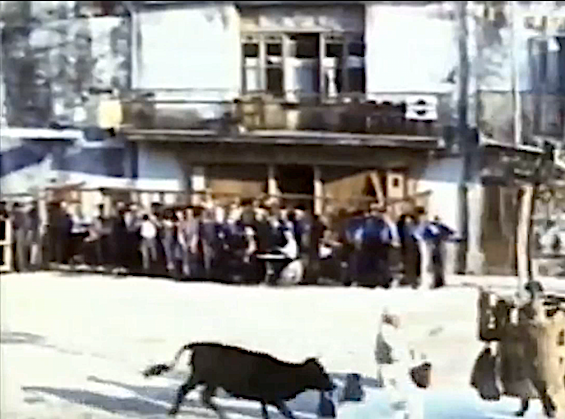
Inolvidable viaje aéreo por los lugares más emblemáticos de Francia. Un excéntrico inventor planea un viaje en globo. Cuando ya está en marcha descubre que su nieto se ha colado a bordo. ☟闘牛の場面もあります。
Jack Lemmon, the narrator of the film's English version, was so impressed with the film that he bought the American rights.
domingo 23 de marzo de 2025
(17:00 España) Castilla La Mancha Media Toros desde Tomelloso (Ciudad Real). Toros de Herederos de José Luis Osborne para Molina, Álvaro Alarcón y Víctor Hernández. (Pulse aquí para ver el festejo en directo)
(17:00 España) Canal Sur Televisión
Toros desde Cortegana (Huelva). Circuito de Novilladas de Andalucía.
Novillos de Espartaco para El Primi, Cid de María y Carlos Tirado. (Pulse aquí para ver el festejo en directo)